
Boat GPS Tracker Guide: What to Know Before You Buy
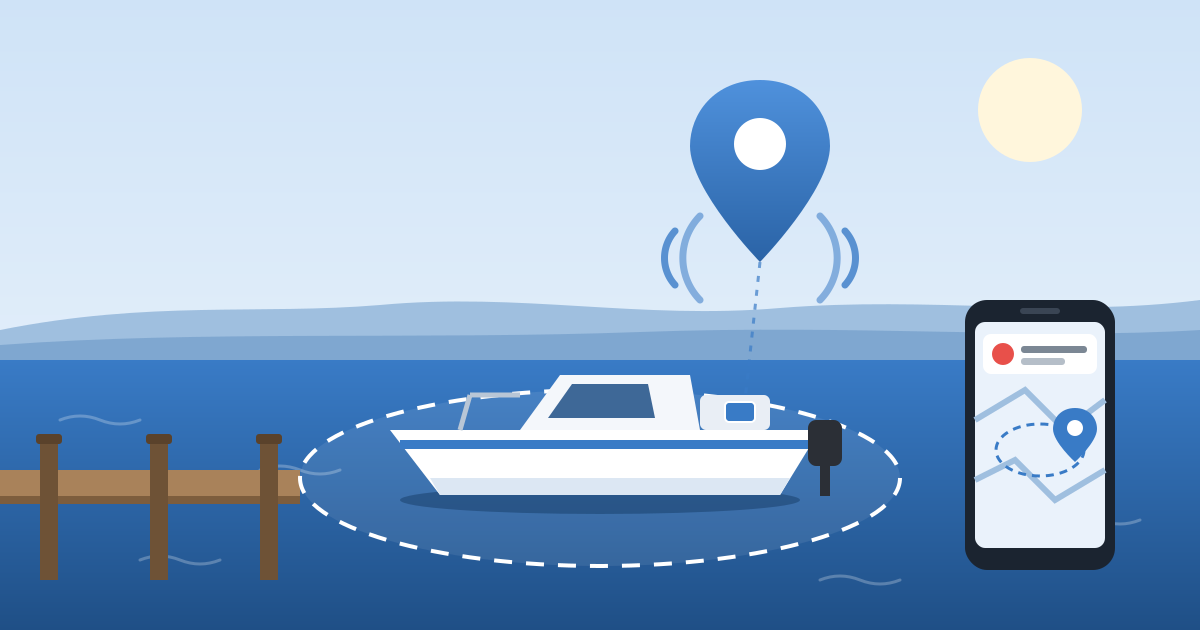
The best boat GPS tracker depends on where your boat is stored and where you take it. For theft protection at a marina, on a trailer, or on inland and near-shore water, a waterproof cellular tracker with movement alerts does the job. For emergencies offshore, beyond cell range, you need a registered 406 MHz EPIRB or PLB, which is a separate safety device.
Getting that distinction right before you buy saves money and prevents a dangerous gap in your safety plan. This guide covers how a boat GPS tracker differs from a car tracker, how cellular and satellite options compare by use case, what theft data says about recovery, and how to power a tracker on a boat that sits for months.
How Is a Boat GPS Tracker Different From a Car Tracker?
A boat tracker has to survive water exposure, work far from cell towers, and run for long stretches without a reliable charge. Car trackers are not built around any of those conditions.
- Water exposure: Look for an IP rating rather than a vague “waterproof” label. Under the IEC standard, IP67 means protection from immersion between 15 centimeters and 1 meter for 30 minutes, while IP68 covers continuous submersion under conditions the manufacturer specifies (Control Engineering). IP testing is based on fresh water, so the rating does not guarantee performance in other liquids such as salt water (Electropages). Mount the device somewhere sheltered from constant spray.
- Coverage: A car rarely leaves cell coverage. A boat can, and a cellular tracker stops reporting once it does.
- Power: Boats often sit for weeks or an entire off-season. A tracker that pulls steadily from the house battery can leave you with a dead bank in spring.
- Relay-based tags: Bluetooth tags depend on nearby phones to pass along their location. A quiet marina at 2 a.m. or open water may have no phones nearby at all.
Cellular vs. Satellite: Which Boat Tracking Method Fits Where You Boat?
Cellular tracking covers most theft scenarios, because boats are usually stolen from trailers, storage yards, slips, and moorings, all places with cell service. Satellite devices matter when you operate beyond cell range, and for most recreational boaters that means a distress beacon rather than a theft tracker.
| Situation | Recommended approach | Why |
|---|---|---|
| Trailered or stored on land | Battery-powered cellular tracker, on the boat and on the trailer | Storage yards and driveways have cell service, and a battery unit needs no wiring |
| Marina slip or mooring | Cellular tracker with a geofence around the slip | An alert fires the moment the boat leaves its berth |
| Inland lakes and rivers | Cellular tracker | Coverage is usually consistent near shore and around launch ramps |
| Near-shore coastal water | Cellular tracker for theft, plus a VHF radio for communication | Coverage fades with distance from shore |
| Offshore, beyond cell range | Registered 406 MHz EPIRB or PLB for distress, plus a cellular tracker for dockside theft protection | Satellite beacons alert rescuers when other communication fails |
The U.S. Coast Guard is clear on the offshore point. It does not advocate cell phones as a substitute for marine VHF radio, and it recommends that boaters operating offshore consider carrying an EPIRB. The 406 MHz EPIRBs and PLBs it describes are designed to alert rescue personnel and give an accurate distress position even when all other communication fails, and they must be registered with NOAA (U.S. Coast Guard, 2023). A theft tracker and a distress beacon solve different problems, and an offshore boat needs both.
What Does Theft Data Tell Boat Owners?
Watercraft theft is common enough to plan for, and recovery is far from certain. Speed of reporting is one of the few factors owners control.
- The NICB counted 4,644 watercraft thefts in 2021 with a 42% recovery rate. Personal watercraft were the most stolen type, with 1,292 thefts and the lowest recovery rate at 37% (NICB, 2022).
- Of the watercraft recovered in that report, 54% came back within a week of the theft and 30% within a day.
- Thefts track the season. The 2021 low was 233 in February and the high was 606 in July, which is exactly when boats sit at docks and on trailers between trips.
- Across all recreational vehicles, including watercraft, ATVs, motorcycles, and snowmobiles, about 63% of those stolen in 2025 remain unrecovered (NICB, 2026).
A tracker with movement alerts shrinks the time between theft and report. If your boat is stolen, report it to law enforcement and your insurer immediately. Federal rules also require owners of state-numbered vessels to notify the agency that issued the certificate of number within 15 days of a theft (U.S. Coast Guard, 2023).
How Do You Power a Tracker on a Boat That Sits for Months?
You have two choices: wire the tracker to the boat’s battery, or use a self-contained battery-powered unit. For boats that sit for long periods, the battery unit is usually the safer bet because it never touches the house or starting battery.
Hardwired to the boat’s battery. A wired tracker can report more often, but it draws power the whole time the boat sits. If you go this route, ask how much the device draws when the boat is stationary and whether it can alert you to low voltage, and keep the batteries on a maintainer during storage.
Self-contained battery unit. The IQ-BATT-3 battery-powered GPS tracker shows what to expect from this category:
- It is waterproof and runs on three AA lithium batteries.
- It sleeps in an ultra-low-power state and wakes when it detects movement, and it can flag after-hours activity.
- Battery life is up to 7 years with once-a-day check-ins, or up to about a year with hourly check-ins. Temperature and conditions affect actual life.
- It stores more than 48,000 records while out of cellular range, so no data is lost.
- At about 3 by 2 by 1 inches, with internal antennas, it is easy to hide in a console, locker, or hatch.
Placement still matters. The device needs to reach GPS satellites and a cellular signal, so test the location history after mounting, especially if you hide the unit deep inside a hull compartment. Browse our portable GPS tracking devices for other wire-free options.
Don’t Forget the Trailer and the Gear
A boat on a trailer is only as secure as the trailer. Put a tracker on the trailer as well as the boat, so you still have a location if a thief separates them. The same approach covers outboard motors, personal watercraft, and other high-value marine equipment with our GPS asset tracking solutions. For trailer-specific features, see our guide on choosing a trailer tracking device.
Boat GPS Tracker Buying Checklist
- Confirm cellular coverage where the boat is stored, launched, and used.
- Check the IP rating, and plan a mounting spot sheltered from constant spray.
- Decide on power: hardwired with a battery maintainer, or a self-contained battery unit.
- Match the check-in frequency to how long you need the batteries to last.
- Set up geofences around the slip, mooring, or storage yard, with movement alerts to your phone.
- Track the trailer separately from the boat.
- If you go offshore, carry a 406 MHz EPIRB or PLB and register it with NOAA.
- Ask your insurer whether a tracking device affects your coverage or premium.
Running boats for a seasonal business, or only need tracking for part of the year? Our GPS tracker rental program builds the device cost into the monthly fee, with no upfront hardware purchase.
Frequently Asked Questions About Boat GPS Trackers
What is the best GPS tracker for a boat?
For most owners, the best boat GPS tracker is a waterproof cellular unit with movement alerts and geofencing, because most thefts happen at marinas, storage yards, and trailers within cell coverage. A battery-powered model avoids draining the boat’s batteries during storage. If you also run offshore, add a registered 406 MHz EPIRB or PLB for emergencies.
Does a boat GPS tracker work offshore?
A cellular tracker keeps calculating its position offshore, but it cannot send that position once the boat is out of cell range. Trackers with onboard memory upload the stored history when they reconnect. For distress alerting offshore, the Coast Guard points boaters to 406 MHz EPIRBs and PLBs, which work through satellites when other communication fails.
Is there a boat GPS tracker with no monthly fee?
Devices that only log location to internal memory or rely on Bluetooth relays can avoid a monthly fee, but they cannot show you where a stolen boat is right now. Sending live location from a tracker to your phone requires a cellular or satellite connection, and that service carries an ongoing cost.
Can a Bluetooth tag protect my boat from theft?
A Bluetooth tag can help as a backup in busy areas, but it should not be your primary protection. Tags only update when a compatible phone passes within range, which may never happen at a quiet marina overnight or on open water. A dedicated cellular tracker reports on its own and can alert you when the boat moves.
Is a chartplotter the same as a boat GPS tracker?
No. A chartplotter is a navigation instrument that shows your position on a chart while you are aboard. A GPS tracker reports the boat’s location to you remotely, even when nobody is on the boat. Most owners who want theft protection need a dedicated tracker in addition to their navigation electronics.
Protect Your Boat Before You Need To
The right setup for most boats is a waterproof, battery-powered cellular tracker on the boat and trailer, with a registered distress beacon aboard if you run offshore. GPS Technologies has been family-owned and operated since 1998, and our team will help you choose the right device for where your boat is stored and how you use it.
Call us at (847) 382-5107, Monday through Friday, 8 a.m. to 5 p.m. Central Time, or contact our team online.
Categorised in: GPS Monitoring Devices
This post was written by GPS Technologies Team
Comments are closed here.