
ATV GPS Tracker Guide: Hardwired vs. Battery for Off-Road Fleets
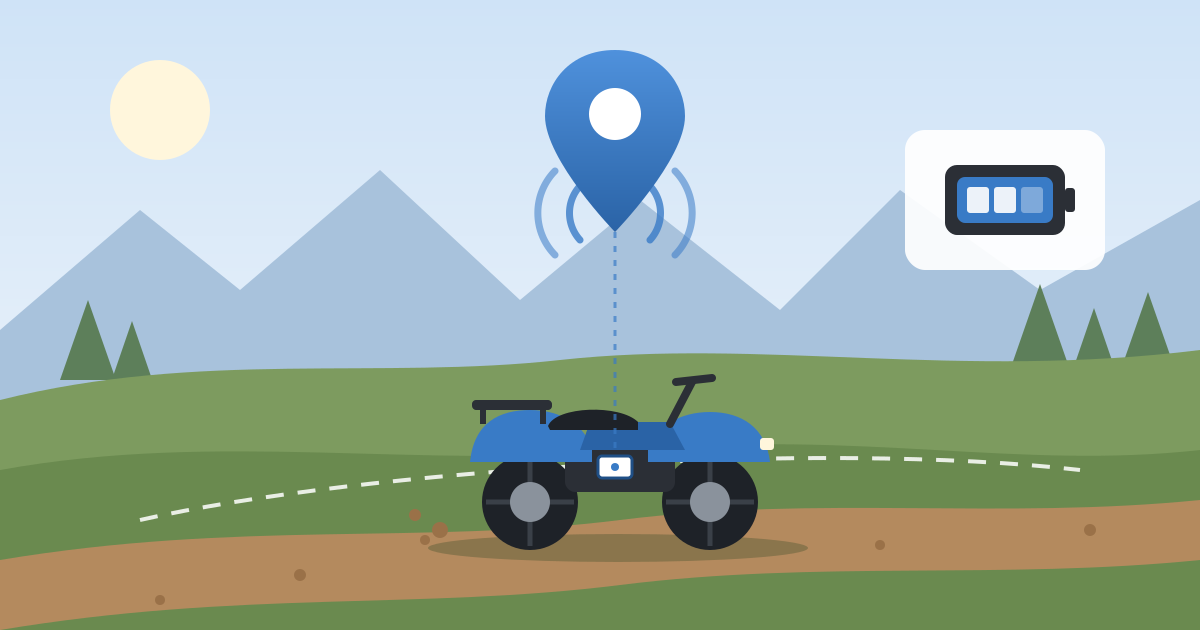
The right ATV GPS tracker depends on power. If an ATV or UTV runs most days and has a healthy 12-volt battery, a hardwired tracker gives you real-time location, ignition status, and engine hours. If the machine sits idle, moves between sites on a trailer, or has no battery worth tapping, a battery-powered tracker is the better fit.
The stakes are real. The National Insurance Crime Bureau counted 11,050 ATVs reported stolen in 2025, and only 23% were recovered, the lowest recovery rate of any recreational vehicle type in its analysis (NICB, 2026). This guide walks through how off-road tracking differs from road vehicle tracking, how the two device types compare, and how to match each machine in your fleet to the right option.
Why Does Off-Road Equipment Need a Different Kind of GPS Tracker?
Off-road machines take more vibration, more mud and water, and spend more time unattended than road vehicles. A tracker that works fine in a pickup can shake loose, take on water, or drain a small battery on an ATV parked for weeks.
Vibration is the first difference. Research funded by the U.S. Department of Energy on off-road utility vehicles found that rough terrain produces low-frequency, high-amplitude vibration, with vertical vibration reaching as high as 2g at speeds under 10 mph, plus occasional or repeated shocks from bumps and obstacles (DOE Hydrogen Program Progress Report, 2005). That is a very different load than the steady hum of a paved road, so mounting and housing quality matter.
Power is the second difference. Many ATVs, UTVs, and towed implements have small batteries, no battery at all, or sit for weeks between uses. Storage is the third. Off-road equipment often lives in barns, open yards, trailers, and remote staging areas where nobody is watching overnight.
Hardwired vs. Battery-Powered ATV GPS Trackers at a Glance
Most off-road fleets end up using both types: hardwired units on the machines that work every day, and battery units on everything else. Here is how they compare.
| Factor | Hardwired tracker | Battery-powered tracker |
|---|---|---|
| Power source | The machine’s 12-volt electrical system, with an internal backup battery on units like the IQ-WIRED-28 | Its own replaceable batteries, with no connection to the machine |
| Location updates | Real-time while the machine is running | Scheduled check-ins, plus a wake-up when the unit detects movement |
| Extra data | Ignition on and off, engine hours, harsh events, optional starter disable | Movement, high-G events, and after-hours activity alerts |
| Installation | Wired into power and ignition, ideally by a professional installer | Mounted and concealed without any wiring |
| Moving between machines | Stays with one machine | Can be moved from asset to asset |
| Ongoing upkeep | None for the tracker itself | Battery replacement on a schedule that depends on update frequency |
| Best fit | Daily-use UTVs, ranch vehicles, and jobsite machines with healthy batteries | Idle, seasonal, rental, or trailer-hauled units, and anything without a battery |
Device details are from the GPS Technologies hardwired IQ-WIRED-28 fleet tracker and IQ-BATT-3 product pages.
When Is a Hardwired ATV GPS Tracker the Right Choice?
Choose hardwired when a machine runs most days and you want live location plus operating data. Because the tracker draws from the machine’s electrical system, it can keep the GPS active the whole time the machine is moving.
Hardwired units also connect to the ignition circuit, which opens up data a battery tracker cannot collect:
- Engine hours: An automatic record of run time, so service intervals are based on actual use instead of operator logs.
- Ignition alerts: A notification when a machine starts after hours or on a day it should be parked.
- Starter disable: An optional relay on the IQ-WIRED-28 lets you remotely immobilize a machine.
- Backup power: The IQ-WIRED-28 has a long-life internal battery that keeps it reporting if the main power is cut.
Concealment is part of the value. A professional install hides the device and wiring behind panels or under the seat, where a thief is less likely to find it. One caution: any wired device draws some power. If a machine regularly sits for weeks, talk through the power draw with your installer, or use a battery unit on that machine instead.
When Is a Battery-Powered Tracker the Better Fit?
Choose battery-powered when a machine has no reliable power, sits idle for long stretches, or moves between sites. These units never touch the machine’s battery, so they cannot leave you with a dead starter when the work season opens.
The IQ-BATT-3 battery-powered tracker is a good example of how these devices work:
- It runs on three AA lithium batteries that you can buy at a hardware store.
- It sleeps in an ultra-low-power state and wakes when it detects movement, and it can also flag high-G events and after-hours activity.
- Battery life is up to 7 years with once-a-day check-ins, or up to about a year with hourly check-ins. Temperature and conditions affect actual life.
- Its internal memory holds more than 48,000 records, so data is not lost while the unit is out of cellular range.
- It is waterproof, has its GPS and cellular antennas inside the housing, and measures about 3 by 2 by 1 inches, which makes it easy to hide.
The trade-off is update frequency. A battery tracker reports on a schedule rather than streaming a live trail, and more frequent updates shorten battery life. For a rental UTV between bookings, a tractor-towed implement, or a machine staged at a remote site, that trade is usually worth it. See all of our portable GPS tracking options for unpowered and mobile assets.
What Features Matter Most on an Off-Road Tracker?
Whichever type you choose, check these specifications before you buy:
- Water and dust sealing: Ask for an IP rating. Under the IEC standard, IP67 means protection from immersion between 15 centimeters and 1 meter for 30 minutes, while IP68 covers continuous submersion under conditions the manufacturer specifies (Control Engineering).
- Secure mounting: Given the shock and vibration off-road machines take, mount the device to a solid surface and check it after the first few weeks of use.
- Internal antennas: Antennas inside the housing make the device smaller, tougher, and harder to spot.
- Geofencing and movement alerts: Virtual boundaries around a yard, ranch, or rental zone turn the tracker into an alarm that tells you when something moves.
- Offline storage: In valleys and wooded areas with weak coverage, onboard memory keeps the location history until the device reconnects.
- Ignition and engine-hour data: If maintenance tracking matters, this requires a hardwired unit.
How Do You Protect an Off-Road Fleet From Theft?
Layer physical security with tracking, and report thefts fast. A tracker does not stop a determined thief, but it gives you and law enforcement a location to work from.
The NICB recommends storing recreational vehicles in locked, enclosed spaces when possible, using multiple layers of protection such as locks, chains, and immobilizers, and keeping records of identification numbers and current photos. It also notes that more than half of recreational vehicle recoveries happen within two weeks of the theft being reported, so speed matters (NICB, 2026).
The problem extends beyond ATVs. In the last detailed public report from the NICB and the National Equipment Register, 11,625 pieces of heavy equipment were reported stolen in 2014, and only 23% were recovered (NICB, 2015). Do not forget the trailers that haul your machines, either. Our guide on what to look for in a trailer tracking device covers that side of the fleet.
Should You Rent or Buy Trackers for Seasonal Machines?
Renting makes sense when machines only work part of the year or you want to test tracking on a few units first. With a rental, the cost of the device is built into the monthly fee, so there is no upfront hardware purchase. Our GPS tracking rental program covers the details.
Frequently Asked Questions About ATV GPS Trackers
Can I put a GPS tracker on an ATV without wiring it in?
Yes. A battery-powered tracker mounts and hides on the machine without any connection to its electrical system. It runs on its own batteries, wakes when the machine moves, and reports on a schedule. This is the simplest option for ATVs with small batteries, machines that sit idle, and equipment you want to move a tracker between.
Will an ATV GPS tracker work where there is no cell signal?
The device can still calculate its position from satellites, but it needs a cellular connection to send that position to you. Trackers with onboard memory store location records while out of range and upload them once they reconnect. You will not get live updates in a dead zone, but you can still see where the machine went.
Do ATV GPS trackers need a monthly plan?
Trackers that report over cellular networks typically include a monthly service plan, because sending location data requires network service. With GPS Technologies, a purchased device involves a one-time device cost, an activation fee, and a monthly plan. Rental units roll the device cost into the monthly fee instead.
Will a hardwired tracker drain my ATV’s battery?
A hardwired tracker draws a small amount of power from the machine. On ATVs and UTVs that run regularly, the charging system keeps up. On machines that sit for weeks or months, that draw adds up, so a battery-powered tracker is usually the safer choice for long-idle or seasonal equipment.
What should I do first if an ATV is stolen?
Pull the tracker’s current location, then report the theft to law enforcement and your insurance carrier right away. Share the location data, the machine’s identification number, and recent photos. NICB data shows more than half of recreational vehicle recoveries occur within two weeks of the theft being reported, so a fast report improves your odds.
Find the Right Tracker for Your Off-Road Fleet
Most off-road fleets do best with a mix: hardwired trackers on the machines that work every day, and battery-powered units on idle, seasonal, and trailer-hauled equipment. GPS Technologies has been family-owned and operated since 1998, and we will help you match the right device to each machine.
Call us at (847) 382-5107, Monday through Friday, 8 a.m. to 5 p.m. Central Time, or request a quote online.
Categorised in: GPS Monitoring Devices
This post was written by GPS Technologies Team
Comments are closed here.